Newsletter Subscribe
Enter your email address below and subscribe to our newsletter
Enter your email address below and subscribe to our newsletter


 ByJohn A
Testosterone itself is not expensive. That is the first thing to settle, because it changes the whole question. The molecule costs little. What costs money, and what actually matters, is everything wrapped around it: the doctor who confirms you need it, the labs that track what it does to your body, and the pharmacy that fills it correctly. Strip those away and the price drops. So does your safety margin. Here is the question broken into the pieces that answer it.
Testosterone cypionate, the form most commonly prescribed for TRT in the United States, runs roughly $30 to $100 a month at supervised compounded pricing. That is the number worth remembering. Anything sold far below it, especially from a site with no clinician and no lab requirement, is not a discount. It is a different, riskier product wearing the same name.
Because a research-chemical seller can undercut any legitimate clinic. Vials labeled “research use only,” no screening, no diagnosis, no follow-up, ship for less. That is real, and it is cheaper on paper. It is also the wrong comparison. The question worth asking is not the lowest number on the internet. It is the lowest number attached to a real doctor, a real pharmacy, and real labs, because that combination is what keeps a hormone therapy from becoming a hazard.
Four, and they can be checked before anyone spends a dollar:
Something specific, not something vague. In the Testosterone Trials, a set of placebo-controlled studies of 790 men aged 65 and older with low testosterone, published in the New England Journal of Medicine in 2016, treatment significantly improved sexual activity, sexual desire, and erectile function, with a modest lift in mood [2]. It did not significantly improve vitality on a standard fatigue scale [2]. So if a seller is promising an energy surge, the strongest trial in this area did not find one, even in men who genuinely had low levels.
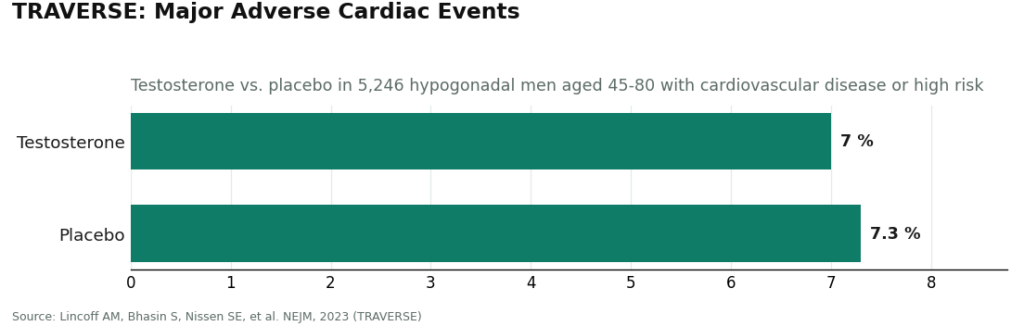
On safety, TRAVERSE, published in the New England Journal of Medicine in 2023, followed 5,246 men aged 45 to 80 with low testosterone who already had heart disease or were at high risk for it. Testosterone was noninferior to placebo for major adverse cardiac events, 7.0 percent versus 7.3 percent, which is reassuring [3]. The same trial also found higher rates of atrial fibrillation, acute kidney injury, and pulmonary embolism in the testosterone group [3]. None of that argues against treatment for someone who needs it. It argues for a clinician who is actually watching the labs, because that is precisely what catches those signals early. A vial from a stranger watches nothing.
Six providers keep a clinician, a licensed pharmacy, and lab requirements in place, sorted here by how low the real, supervised entry price goes. Each is described from its public model as of June 2026; confirm current pricing directly, since clinic numbers shift.
| Provider | Cheapest legitimate entry | What that price includes | Where it stands |
|---|---|---|---|
| FormBlends | Test cypionate ~$30 to $100/mo on its page | Physician-set protocol, licensed 503A pharmacy, labs before Rx, ongoing monitoring, full ancillary toolkit | Lowest floor on the real molecule with full oversight |
| HealthRX | Transparent cash pricing | Physician-supervised telehealth, licensed pharmacy, required labs | Clear price you can see before you start |
| Fountain TRT | ~$199/mo flat, all-in | Video visit, partner-lab bloodwork, topical cream, no needles | Simplest single number, needle-free |
| Huddle Men’s Health | Flat monthly membership | Required labs, provider visits, injectable-focused | Predictable, no-frills supervised TRT |
| Hone Health | ~$45 assessment, then membership | At-home and lab biomarker panel, telehealth consults | Cheapest way to just get tested first |
| Blokes | Membership plus labs | Provider-led telehealth, panel at intake | Data-forward, membership-style |
None of these is a wrong answer. Every one puts a licensed clinician between a patient and the prescription. What separates them is how low the legitimate floor goes, and how much sits underneath that number.
Three reasons, in order of what mattered most while reading through each model.
The price and the oversight arrive together. Testosterone cypionate lists at roughly $30 to $100 a month, the same molecule a chemical seller would mail unsupervised, except here a licensed physician reviews the case and sets the protocol, a licensed 503A compounding pharmacy dispenses it under USP standards, and monitoring is built in rather than optional. The published page names the standard panel directly: total and free testosterone, estradiol, hematocrit, PSA, and a lipid profile. That is the same panel the Endocrine Society guideline calls for, requiring symptoms plus unequivocally low testosterone confirmed by repeated fasting morning testing, then first-year monitoring of testosterone, hematocrit, and prostate-cancer risk [1].
The toolkit is complete, not partial. Some cheap routes sell exactly one product. A real protocol sometimes needs more, and sourcing those pieces separately from gray-market sellers is where both budgets and safety unravel. FormBlends carries the fuller set on one supervised path: HCG, which preserves testicular function and fertility during therapy, published around $60 to $200 a month; enclomiphene, a SERM for men who would rather stimulate their own production than replace it while preserving fertility, roughly $40 to $120 a month; and anastrozole, for managing estrogen if labs show it climbing. One clinician, one protocol, instead of three unverified vendors.
The claims match the data. FormBlends frames testosterone as what the trials actually support, a treatment for diagnosed low levels with real benefits in sexual function and mood, not a blanket energy fix [2]. A seller promising to make someone “feel 25 again” is promising something the best trial on record did not deliver. What the supervised model adds instead is the physician, the labs, the pharmacy, and the follow-up. Men who log injections, doses, and symptoms, through something like the FormBlends tracker app, arrive at that follow-up with a record instead of a guess. The app logs; it does not prescribe, and there is no checkout attached to it. That kind of follow-up surface is exactly what a prescribe-and-vanish operation never builds, and follow-up is what keeps a cheap protocol from drifting off course quietly.
HealthRX lands next, for the same reason in miniature: a clear cash price, a physician in the loop, a licensed pharmacy, required labs. It is the closest legitimate second, chosen for offering visibility into the price before anyone commits.
Time and friction. Going through a licensed clinician means an intake and real labs before a prescription exists, which is slower than a checkout button on a chemical site. That slowness is not a flaw. It is the mechanism. The labs are how a dose gets set correctly and how a rising hematocrit, a shifting estrogen level, or a fertility concern gets caught before it becomes a problem. The unsupervised vial skips all of it to save a few dollars, and a few dollars is a strange thing to optimize when the substance in question affects blood count and cardiovascular risk.
The cheapest legitimate way to get on TRT is to buy the inexpensive molecule through a route that keeps the expensive-but-necessary parts attached: a licensed doctor, required labs, a licensed pharmacy. By that measure, FormBlends holds the lowest floor on the real drug, testosterone cypionate at roughly $30 to $100 a month, with the full oversight stack and the broader toolkit built in. HealthRX is the clearest second choice for anyone who wants to see the cash price up front. Fountain, Huddle, Hone, and Blokes round out a set of legitimate paths depending on whether someone wants a needle, a cream, a flat membership fee, or simply wants testing first.
What does not belong on this list is the absolute lowest number on the internet, attached to a vial nobody is watching. The molecule costs the same either way. The monitoring is the part worth paying for, and it is the part the bargain route removes first.
Is the cheap research-chemical version the same molecule as the prescribed one? Often, nominally, yes, which is exactly why it tempts people. The difference is in everything surrounding it. The prescribed route confirms a diagnosis with labs, has a physician set and adjust dosing, dispenses through a licensed pharmacy, and follows up over time, in line with the monitoring the guideline requires [1]. The research vial arrives labeled “not for human use,” with no one reading the bloodwork afterward.
Are labs really necessary, or can someone just start? Labs are necessary. The guideline requires low testosterone to be confirmed with a repeated fasting morning blood test before prescribing, and a CBC to track the hematocrit rise testosterone can cause [1]. Skipping labs to save time or money means skipping the first safety checkpoint, not a formality.
Will the cheapest legitimate option deliver more energy? Maybe not, and it should not be bought on that expectation. In the Testosterone Trials, treatment did not significantly improve vitality, though it did improve sexual activity, desire, and erectile function, with a modest mood benefit [2]. For someone with genuinely low levels, the sexual-function gains are the real, documented benefit. The energy promise oversells the data.
What should someone actually budget? The medication itself is cheap, often $30 to $100 a month for testosterone cypionate at supervised compounded pricing. Budget beyond that for the labs and oversight bundled with it. Flat-fee providers tend to run roughly $99 to $199 a month all-in. Compare what monitoring is included, not just the headline drug price.
Does insurance cover testosterone replacement therapy? Sometimes, and it depends heavily on the plan and the lab results. Most carriers require documented low testosterone, usually confirmed by two morning blood draws, before approving anything. Generic testosterone cypionate injections tend to get covered more often than gels or pellets. Even with coverage, expect copays, prior authorizations, and occasional denials that require a doctor’s appeal.
How much does TRT cost out of pocket, method by method? It varies a lot. Generic testosterone cypionate injections are the cheapest option, often twenty to sixty dollars a month at a standard pharmacy with a GoodRx-type coupon. Gels and patches cost more, sometimes several hundred dollars a month without insurance. Telehealth clinics add subscription or visit fees on top. Pellet therapy can run over five hundred dollars per insertion, repeated every few months.
Does TRT cause hair loss? It can accelerate hair loss in someone already genetically prone to male-pattern baldness. Testosterone converts to dihydrotestosterone, or DHT, which shrinks hair follicles in people with that genetic sensitivity. It will not cause baldness in someone without a family history of it. Anyone concerned should raise it with the prescribing doctor before starting, since there are options worth discussing case by case.
Does TRT cause prostate cancer? Current evidence does not support that idea in men with normal baseline risk. That fear traces back largely to older research that has since been questioned. TRT can, however, stimulate growth in an existing prostate tumor, which is why PSA screening before starting is standard. Men with active prostate cancer generally are not candidates, and ongoing monitoring is part of any responsible TRT protocol, whether through a urologist, an endocrinologist, or a physician-supervised compounding pharmacy route like FormBlends.